


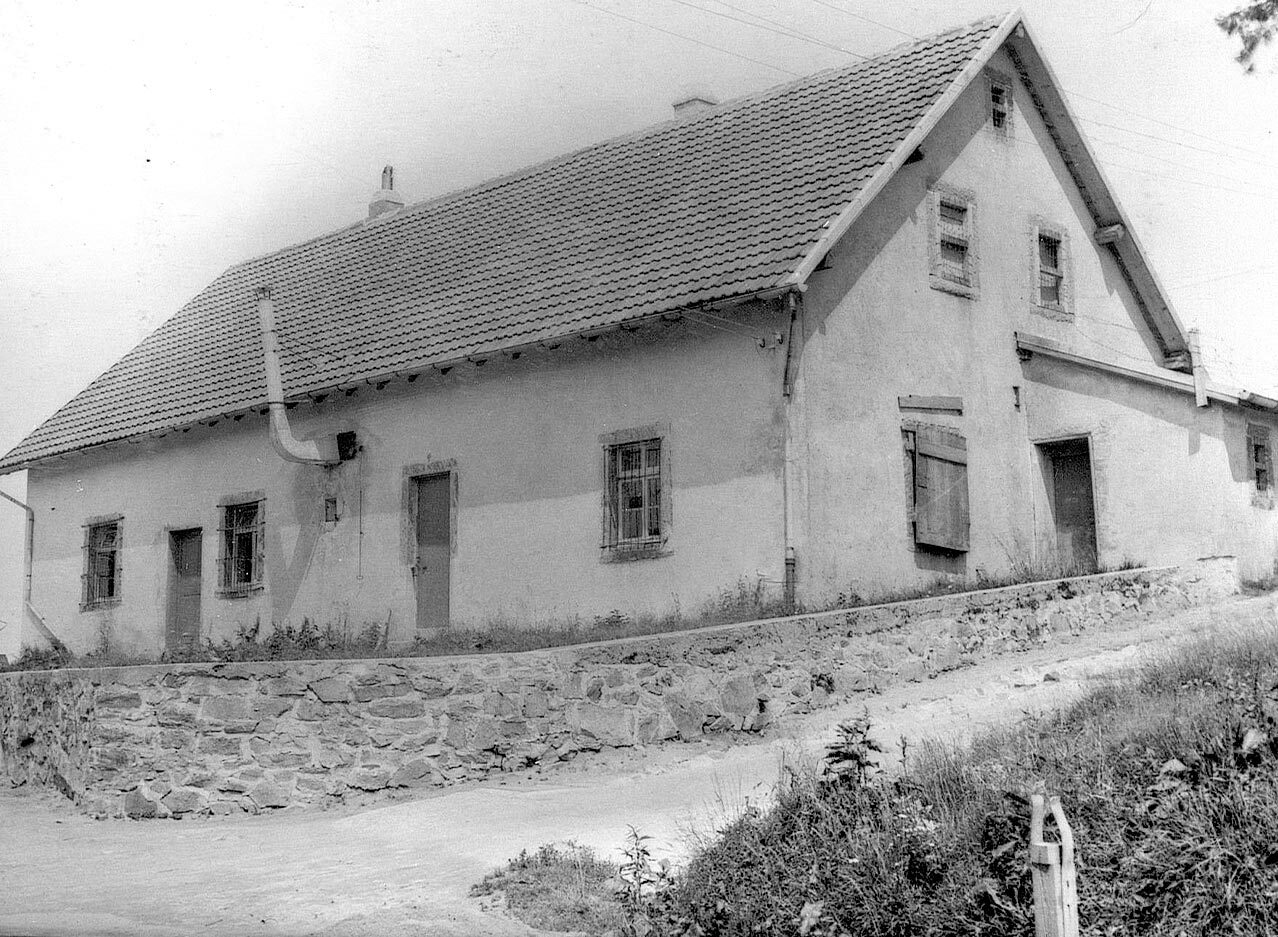
The gas chamber
CONTENTS
- A detached building situated below the camp
- A gas chamber in a concentration camp
- The ballroom at the Struthof Inn
- Construction of the gas chamber
- The technical system and how it was used for criminal purposes
- The gas chamber today
A detached building situated below the camp
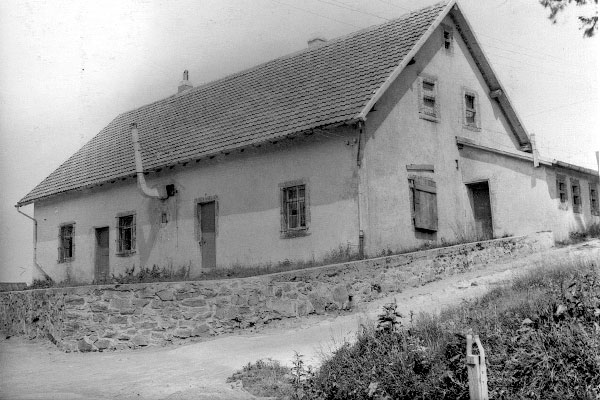
Located 800 metres below the upper camp, the gas chamber was constructed in a “harmless-looking little house”, as Commander Robert Jardin explained during the military court-martial investigation into the war crimes committed at the camp. This building was formerly the ballroom of the Struthof Inn, which hosted dances and banquets before the war.
A gas chamber in a concentration camp
The gas chamber (G-Zelle) is in no way comparable to the facilities built in the extermination centres such as Auschwitz or Treblinka. It was not intended for mass murder as part of the Final Solution. Natzweiler was a concentration camp, not an extermination camp.
Gas chambers existed in other concentration camps such as Mauthausen and Ravensbrück, often to dispose of prisoners who were too weak or ill, while others, such as those at Dachau, were never completed. They were never used on a permanent basis. The specific case of Natzweiler illustrates the purpose of such a building. It was an experimental gas chamber designed to satisfy the needs of two doctors, Otto Bickenbach and, in particular, August Hirt, as part of their experimental research.
The ballroom at the Struthof Inn
This ballroom, which was requisitioned in November 1940, was initially used to house the first deportees, who slept on the floor covered with straw. It looks rather unremarkable, measuring 20.15 metres by 10. It has six windows, two front entrances and one side entrance, and comprises six rooms.
The front door on the right leads to a corridor that opens onto two rooms where the SS stored equipment and food supplies. Another door in this corridor leads to the actual gas chamber, which is accessible via the second door at the front. From there, there are three other rooms that served as reception rooms before the war, including a kitchen and a room with three tiled vats, which opens onto the side door, which visitors use to begin their tour.
The three deep vats, each 1.7 metres deep, were never used to store bodies but, most likely, to preserve food.
Construction of the gas chamber
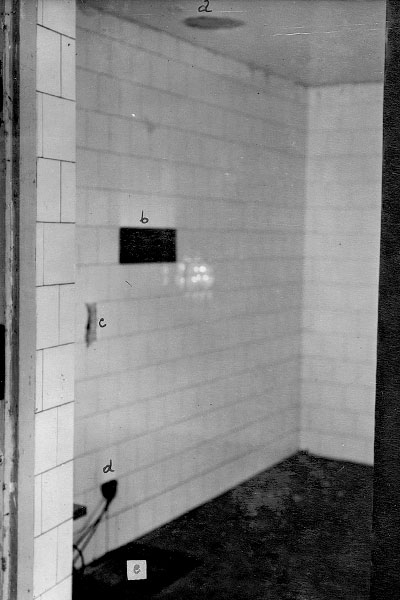
Work on building a gas chamber ex-nihilo began in the autumn of 1942. A separate room had to be constructed by erecting partition walls. The gas chamber, measuring 9.25 m2 and with a capacity of 22.2 m3 (2.91 m wide × 3.18 m long × 2.40 m high), was completed on the 12th of April 1943.
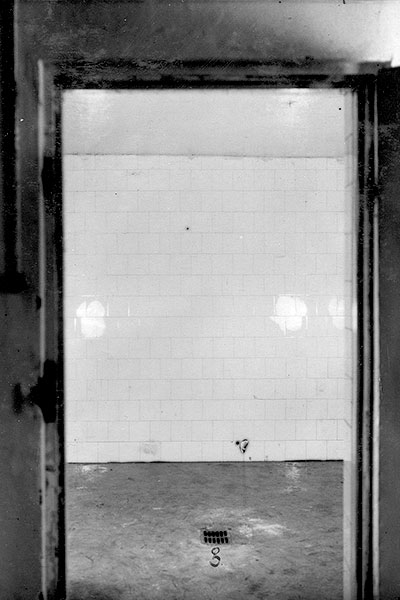
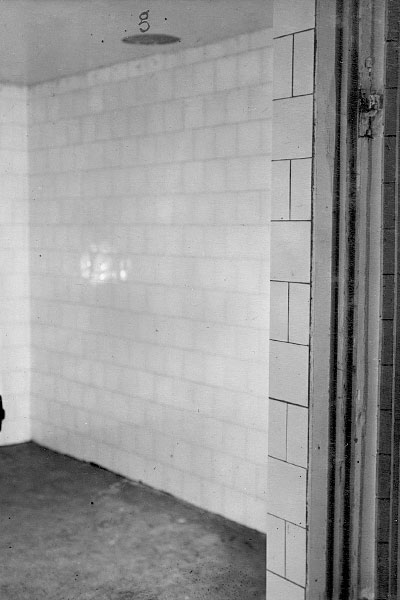
The walls were covered completely with white ceramic tiles. The ceiling, fitted with a ceiling light, was painted and a drainage grate was installed in the concrete floor. It was closed off with a thick, airtight door reinforced with a sheet metal plate. The door that leads to the room containing the chamber was covered with newspapers to make it airtight.
The technical system and how it was used for criminal purposes
There is a glass-panelled window fitted on the left-hand side of the room, protected on the inside by a metal grille. Below it on the right, there is a hole fitted with a metal funnel, extended by a pipe that runs through the wall into the gas chamber and ends above a square excavation in the floor.
It was used by Commander Kramer to inject cyanide salts which, on contact with water, released a deadly gas used to murder the 86 Jews in Hirt’s “anatomical collection”. The room can be lit using a switch located to the right of the window. Ventilation to extract the gases was provided by a fan connected to an external flue.
The gas chamber today
The gas chamber, which was restored in 2022, features various information panels about the Reichsuniversität in Strasbourg and the doctors and their medical experiments, while also serving as a memorial to the victims.
-

Interior views of the gas chamber: a) electric ceiling light b) observation window c) hole cut in the wall for a pipe d) power socket e) square hole in the floor g) drainage grate. © ALBUM JARDIN, PROCÈS NATZWEILER 1955, DCAJM, LE BLANC -
Interior views of the gas chamber: g) drainage grate. © ALBUM JARDIN, PROCÈS NATZWEILER 1955, DCAJM, LE BLANC -
Interior views of the gas chamber, (g) grille at the inlet of the gas exhaust duct © ALBUM JARDIN, PROCÈS NATZWEILER 1955, DCAJM, LE BLANC -
Exterior view of the annex to the gas chamber at the Natzweiler-Struthof concentration camp © ALBUM JARDIN, PROCÈS NATZWEILER 1955, DCAJM, LE BLANC
To find out more
STEEGMANN Robert, Struthof. Le KL-Natzweiler et ses kommandos : une nébuleuse concentrationnaire des deux côtés du Rhin. 1941-1945, Strasbourg, La Nuée Bleue, 2005, p. 313-316.
BONAH Christian, GAUME Sandrine, LANG Hans-Joachim, LUTZ Loïc, MOSER Gabriele, SCHMALTZ Florian, La médecine nazie contre l’humanité. Expérimentations médicales au camp de concentration de Natzweiler-Struthof, Paris, Tallandier, 2024, p. 54-59.
Source and captions for the illustrations
The photographs are from the DCAJM (Central military justice archive repository, Natzweiler trial, 1958).