


The Ballersdorf case
CONTENTS
- Refusal to be conscripted
- An attempt to cross into Switzerland
- A ruthless Gauleiter
- A trial before the Sondergericht
- A travesty of justice
- The execution at KL Natzweiler
- The last victim
Refusal to be conscripted
Following the defeat at Stalingrad on the 2nd of February 1943, Gauleiter Robert Wagner believed that Alsace should fully enter into the battle Germany was waging for its survival. However, protests against conscription into the Wehrmacht were becoming increasingly widespread. So, on the 10th of February, 183 draft dodgers from villages in the Sundgau region, led by non-commissioned officers of the French army, reached Switzerland. A further 205 young people from the Sundgau region (Waldigshoffen, Muespach, Grentzingen, Oberdorf, Ruederbach, Riespach and Feldbach) joined them during the night of the 11th to the 12th of February. For Wagner, there could be no question of showing weakness now that the Reich was fighting a battle for its very survival. Those who refused to fulfil their duty were traitors who had to be eliminated.
An attempt to cross into Switzerland
On Thursday the 11th of February 1943, young men from Ballersdorf born between 1914 and 1919 registered on the conscription list in preparation for their enlistment. On the street and in front of the town hall, young people were discussing the chances of crossing the border. Discussions continued at the Barth restaurant. Their conviction was firmly rooted: under no circumstances would they serve in the feldgrau uniform.
The two instigators were Aloyse Boll and René Grienenberger, from Ballersdorf, with the latter responsible for liaising with the young people from Retzwiller, Aspach and Dannemarie. The problem that these young people were facing was finding a reliable smuggler to take them to Switzerland.
On Friday the 12th of February, between 7pm and 8pm, a group of young people gathered at the home of their friend, René Grienenberger. They still didn’t have a smuggler. They persuaded their friends to give it a try and agreed to meet at 10 pm at the southern exit of the village.
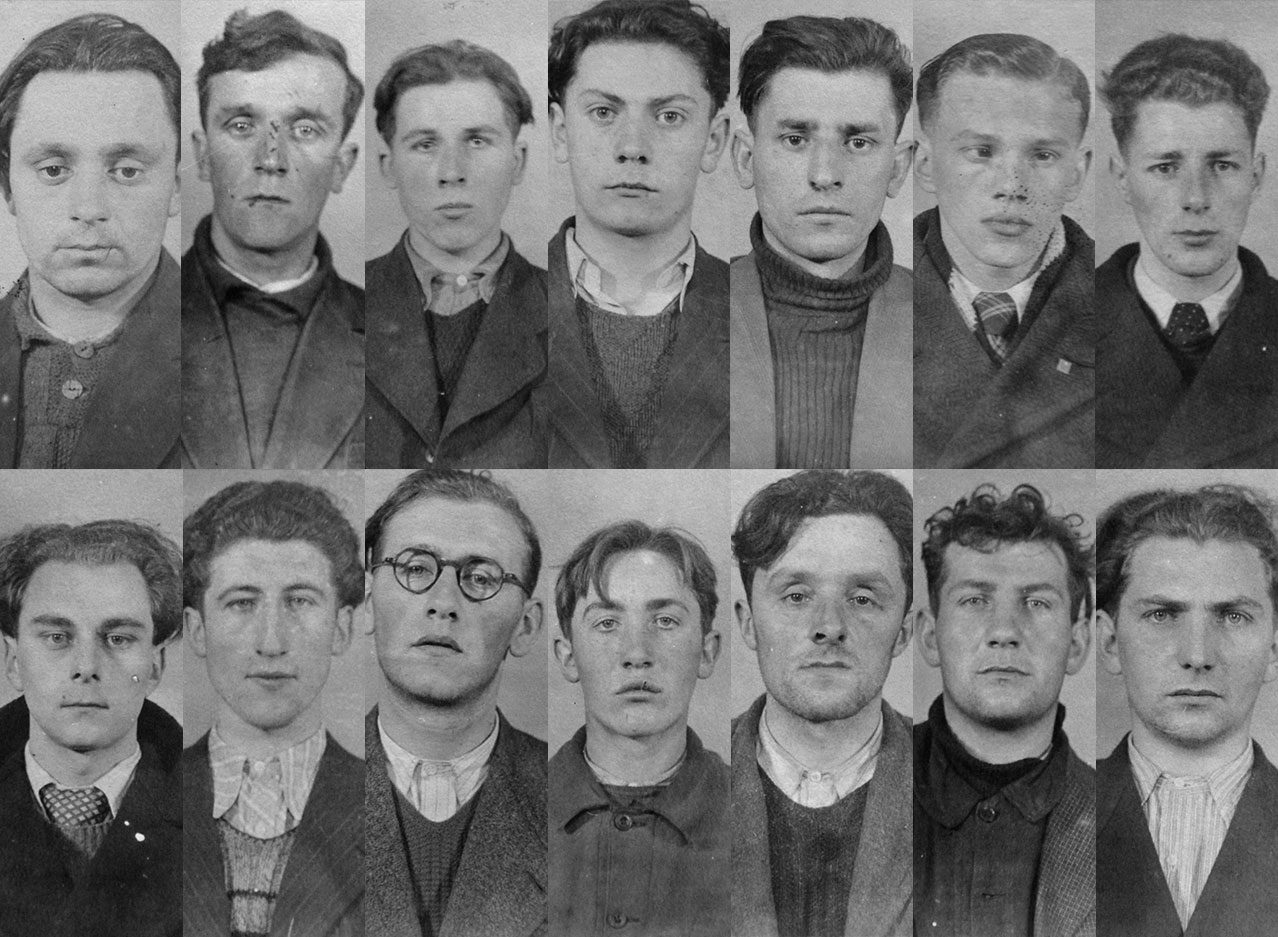
In the end, there were 18 of them:
- from Ballersdorf: Camille Abt, Aloyse Boll, Charles Boloronus, Justin Brungard, Eugène Chéray, René Grienenberger, Henri Mihé, Charles Muller, Charles Wiest (03/03/1914), Ernest Wiest and brothers Charles (05/07/1914) and Maurice Wiest,
- from Elbach: Peter Paul,
- from Retzwiller: Alfred Dietemann, Aimé Fulleringer and René Gentzbittel,
- from Aspach: Joseph Burgy,
- from Dannemarie: René Klein.
The group had six muskets and four revolvers salvaged from the retreat of 1940. The planned crossing point was near Seppois-le-Haut. The small group headed for the village of Fulleren and then followed the railway line running from Dannemarie towards Switzerland. Around midnight, they arrived near Seppois-le-Haut. Shortly afterwards, the group arrived at the small railway bridge located 100 metres to the south. At around two o’clock in the morning, as they were climbing the embankment towards the bridge, they were stopped by two border police officers. A gunshot was fired. We will never know for certain who fired it. The two sides fired shots at each other. Three of the young men were killed: Aimé Burgy from Aspach, Charles Wiest (03/03/1914), who was shot in the head, and Ernest Wiest, who had come to Charles’s aid. The others fled.
The bodies of the three victims were taken to the Strasbourg crematorium on the 13th of February under police escort. An injured German border guard died the following day in a hospital in Mulhouse. The Germans found the list of those who took part on Ernest Wiest’s body. A search operation (Sonderfahndung) was carried out by border officials, the gendarmerie, the Wehrmacht and the Gestapo in Mulhouse.
All the youths were arrested on the 13th and 14th of February and were subsequently detained at Mulhouse Prison. René Grienenberger, who managed to evade capture, hid out for three days on a farm in Bisel. He then went into hiding from the 15th of February until the 8th of May at the Sennhütte farm, between Bisel and Largitzen, before crossing the border into Saint-Louis. He was detained in Switzerland and, on the 3rd of November 1944, he joined a group of men from Alsace in the GMA at Ornans.
A ruthless Gauleiter
On learning what had happened, Gauleiter Wagner flew into a fit of rage and met with the head of the Sipo-SD, Hans Fischer, on the morning of the 13th of February. He demanded that the young men be executed immediately – which would amount to murder – thereby exceeding his powers as Gauleiter, but the RSHA objected. Meanwhile, whilst the investigation was still in its early stages, Gauleiter Wagner ordered the relocation of the youths’ parents to the Altreich (the Reich prior to annexation) on the 14th and 15th of February. Since a straightforward assassination was out of the question, the Gauleiter nevertheless wanted a sentence that would serve as a warning, and he struck a deal with Fischer to ensure the case would be dealt with swiftly. The interrogations took place on Saturday 13th and Sunday 14th at the Gestapo headquarters in Mulhouse. The youths were brutalized by the police.
A trial before the Sondergericht
On the morning of the 14th of February, the Gauleiter was informed of the latest developments in the investigation. He called Ludwig Luger, the public prosecutor at the special court (Sondergericht) in Strasbourg, who was at his beck and call. He scheduled the trial for the 16th of February. Luger and Richard Huber, the presiding judge of the Sondergericht, paid a visit to Fischer, who handed them the Ballersdorf file. He informed them that, on the advice of the Gauleiter, they would have to act swiftly and impose the death penalty on the 14 accused. Before they had even appeared in court, the young men from Ballersdorf had already been convicted. The date of their execution was even set in advance.
On the 15th of February, the young men were transferred to the Vorbruck-Schirmeck security camp and placed in cells in the shower block, opposite the kitchens. Beaten and deprived of food, they were forced to endure the “pelote” (crawling through the mud) for between one and a half and two hours in the rain. Early the next morning, they were taken by van to Strasbourg, but not before having been savagely beaten.
A travesty of justice
Upon arriving at presiding judge Huber’s office on the morning of the 16th of February, the lawyers were informed by public prosecutor Luger that they were to defend 14 young men whose trial was due to take place that very day at 2.30 pm. They would not see their clients beforehand and were unaware of the charges.
Shortly before the start of the hearing, the young men arrived. They were handed the indictment in the presence of their lawyers. It was already past 2.30 pm. The trial began at 3 pm. Prosecutor Luger read out the indictment and placed emphasis on the death of the police officer. The lawyers objected because two of the defendants, Justin Brungard and Charles Müller, were minors. The prosecutor replied that they had to be tried as adults. The proceedings were brief, and Huber was particularly incisive in his questioning of the defendants, who clearly did not realise what was at stake. In the court’s view, if only one person fired the shot – and it was not known who – then all of them were complicit in the murder of the German border guard. The case of Charles Müller was referred for psychiatric assessment to determine the extent of his criminal responsibility.
At 9.30 pm, President Huber handed down 13 death sentences, including one against the minor, Justin Brungard. The convicted prisoners were immediately taken by lorry to the Vorbruck-Schirmeck security camp and locked up in cells. That evening, Buck received a telegram from the RSHA ordering their execution, specifying the exact date and time.
Before midnight, Luger went to the Gauleiter’s private residence to inform him that an appeal for clemency would be lodged the following day. Wagner explained that he was waiving their right to clemency and that he had already instructed the Gestapo to carry out the executions.
The execution at KL Natzweiler
At seven o’clock on the morning of the 17th of February, the young men were taken from their cells. They were made to climb into the green van belonging to KL Natzweiler, chained together in pairs. Buck informed the youths that their appeal for clemency had been rejected and that they were to be executed within an hour. He read them the report in that morning’s newspaper announcing their conviction and their planned execution. None of them uttered a word.
At around 9 o’clock, the siren sounded within the snow-covered grounds of KL Natzweiler. All the prisoners were locked up in their barracks. The prisoners from the Sandpit Kommando (Kiesgrube) were sent to the coal cellar, located opposite, to fetch the bulletproof shield. This was a thick wooden panel erected at the far end of the Sandpit where there was no execution post. The victims were brought in by lorry. They were not registered. They were taken to Block 1 – the administrative block – and locked in the punishment cell. They were given striped prison trousers.
SS-Hauptsturmführer Heidrich, commander of the guard company, selected a squad of 15 men. The squad reached the quarry where SS officers Wolfgang Seuss and Willy Bensch, Commander Kramer and his deputy Volkmar, as well as various military and civilian figures were present: prosecutor Luger of the Sondergericht, the Camp Schirmeck commander Karl Buck and a Gestapo officer from Strasbourg.
The squad got into position in a single file. The Blockführer lead the young men in groups of five, wearing wooden clogs, striped trousers and with a striped jacket thrown over their shoulders. They were positioned facing the bulletproof wall, and then their jackets were removed. The squad was located approximately 12 metres away. The execution was horrific. The first round of shots went badly, as the squad was deeply troubled by the thought of firing on such young boys. Several of them were not killed instantly but were injured. Heidrich took out his pistol to deliver the fatal blow, but the gun jammed. Bensch and Seuss then delivered the fatal blows. On Kramer’s orders, Seuss immediately took command. When it came to the second group of five victims, the shooting was even worse because several men had forgotten to take the safety catch off.
Then came the last group of three. It was then that one of the three young men turned his head towards the SS and said he wanted to look his murderers in the eyes. He held his position until he fell. The bodies were thrown into wooden crates, from which blood dripped onto the white snow. The crates were loaded onto a lorry bound for Strasbourg’s municipal crematorium. The clothes were collected by two prisoners from the tailors’ Kommando.
The last victim
Charles Müller, aged 17, underwent psychiatric assessment in Strasbourg. Having been found responsible for his actions, he was sent to the Vorbruck-Schirmeck security camp. An execution order was received from Berlin, and Buck ordered the prisoner to be transferred to Natzweiler. He was shot on the 24th of February 1943, along with two other men from Alsace: Paul Munier and Henri Jaeglé.
Sources
- Archives d’Alsace, Strasbourg: 150AL14, 150AL17, 150AL42.
- DCAJM: trial of 1958.
- SHD, DAVCC: Series 21 P: files relating to the victims in the case.
- SHD, Vincennes: 16 P 270449: file of René Grienenberger.
- www.maitron.fr: biographical files on those executed by firing squad in Ballersdorf.
- https://collegedelalargue.fr/biographie/
- Frédéric Stroh, Association for Studies on the Internal Resistance of the Alsatians (AERIA) (illustrated by Christophe Clavel), “Le drame de Ballersdorf (Haut-Rhin)”, in Eric Le Normand, La résistance des Alsaciens, Fondation de la Résistance, AERI department, 2016.