


The “ravin de la mort” (The ravine of death
CONTENTS
- General background
- The Wheelbarrow Kommando
- Albert Fuchs and Josef Van der Mühlen, the instigators of the atrocities
- The victims of the “Ravine of Death”
General background
On the 9th of July 1943, the first convoy of French NN prisoners (political deportees) was registered at KL Natzweiler. Two more transports followed on the 12th and 15th of July. These transports followed on from a convoy of Norwegian NN prisoners who arrived at the camp on the 15th of June.
This transfer of NN prisoners to Natzweiler was pursuant to a directive issued by the WVHA on the 7th of June 1943, ordering the commanders of concentration camps to transfer all prisoners of Germanic origin classified as “NN” to KL Natzweiler.
Commander Josef Kramer painted a particularly damning picture of these French NN prisoners for his men. In his view, they were nothing more than a bunch of criminals (pimps, murderers, rapists, etc.), scum rounded up in the Vieux-Port, the dregs of society who needed to be eliminated within a month. Unrestrained violence, justified by the hierarchy, would be unleashed on the new arrivals as soon as they stepped off the train at Rothau station. On the 10th of July, the prisoners who had arrived the day before were subjected to the “pelote”. Under a barrage of blows, forced to run, they were made to carry heavy stones along the western boundary of the camp, on the side of Villa Ehret and further out as they climbed the slope. SS men Witzig and Ehrmanntraut unleashed beatings with batons and agitated the dogs, which they then set upon them.
Then, along with many of their comrades on the 12th and 15th of July, they were sent to the Kartoffelkeller work site, under the command of Ehrmanntraut, alias “Fernandel” – a Kommando that would soon become known as “Dante’s Inferno”. Another group of French NN prisoners were assigned to build a road under the Straßenbaukommando, led by SS-Unterscharführer Albert Fuchs. It is against this backdrop that the “Ravine of death” episode took place.
The Wheelbarrow Kommando
Mission and operations
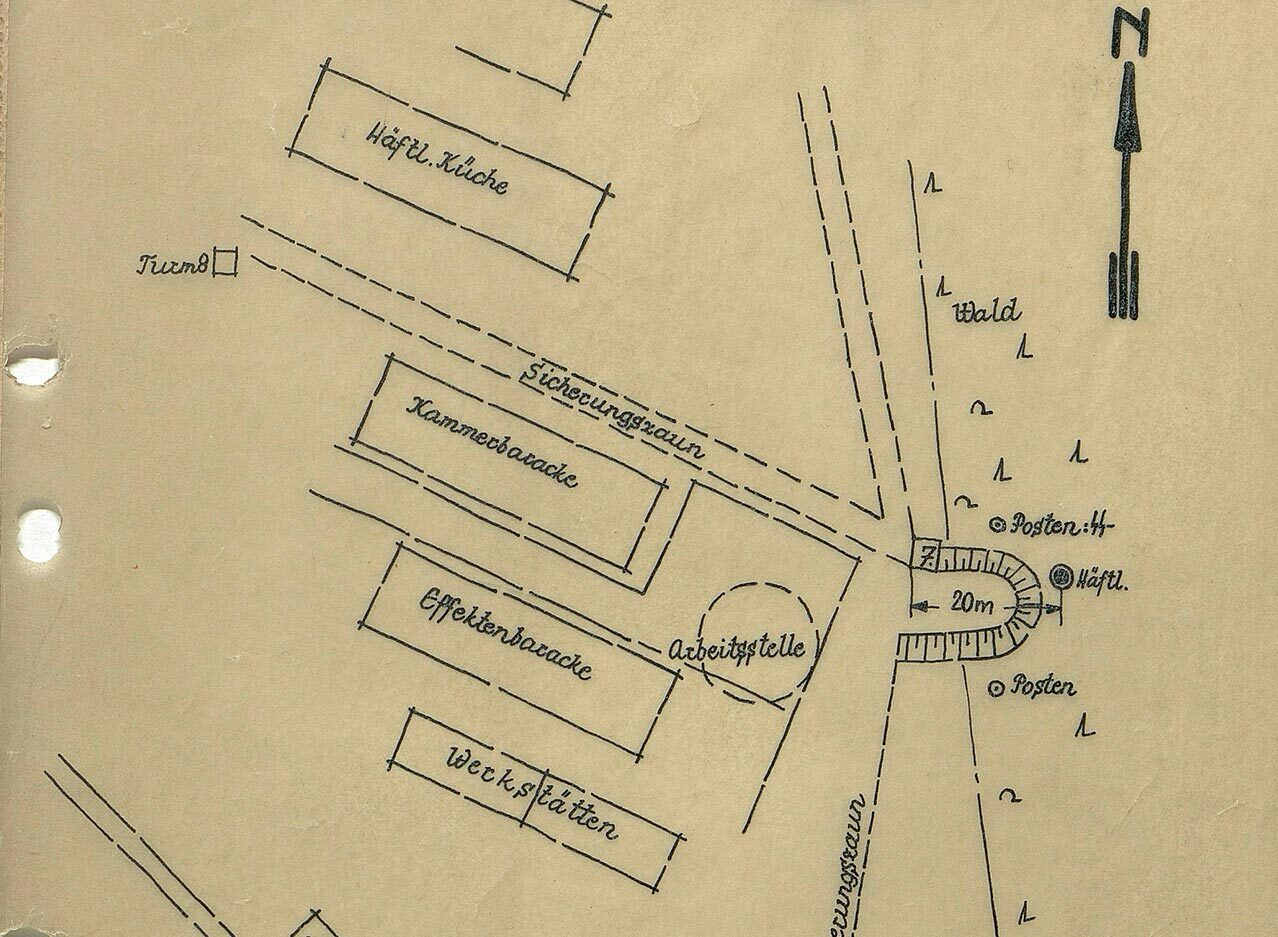
This construction project, nicknamed the “Kommando des brouettes” or “Wheelbarrow Kommando”, began in July 1943. The prisoners were tasked with clearing rubble and stones near watchtower 7 at the south-eastern corner of the camp, near the Kammerbaracke (the Quartermaster’s barracks, a storehouse for the clothing of civilian and striped-uniformed deportees, staffed by professional tailors). The Germans cut a gap in the single row of barbed wire near watchtower 7 so that the deportees could run, in their clogs, across the slippery, damp ground to empty the wheelbarrows of earth onto an embankment. A mound of earth gradually formed in front of a wood, forming a semicircle with an SS sentry on either side. The embankment, part of which was located outside the barbed-wire fence, extended as the excavated material was added. The resulting mound was situated about fifty metres from the camp, thirty to forty metres from the workshop barracks. The gap was systematically closed at night.
The official aim was to build a path that would go around the Effektenkammer or Bekleidungskammer, or clothing barracks, which was responsible for various workshops, as well as the washing, distribution and disinfection of clothing, and the management of prisoners’ money and personal effects. These barracks were located one terrace higher up, in the SS section of the camp, just below the workshop (Werkstatt) where various trades were based (radio repairs, mechanical and electrical repairs, carpenters, locksmiths, etc.). However, there was no real need to build this path, as there was already a path leading to the west entrance of the Effektenkammer, which, incidentally, had only this one exit. The pretext of the construction site was in fact to physically torture and eliminate these despised “NNs”.
Albert Fuchs and Josef Van der Mühlen, the instigators of the atrocities
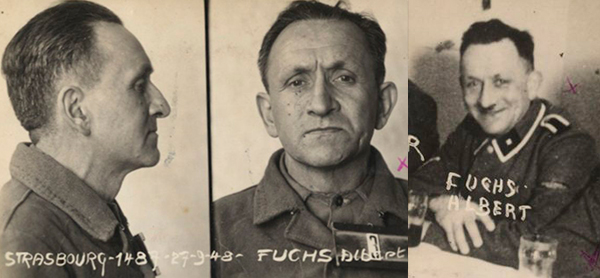
Albert Fuchs, head of the Straßenbaukommando
Born on the 12th of October 1894 in Kehl, he learned the trade of painter and decorator. Albert Fuchs enlisted as a volunteer in the navy in 1912 and served until 1918. He got married and worked for a time in Strasbourg as a fitter and mechanic at the Chenard-Walker factory, and later at the Mathis factory. Having been unemployed since 1933, he was placed by the employment office in the customs service until 1936. He then worked as a surveyor at the office of the Reich for the purpose of land composition surveys. From 1937 to 1939, he worked at the finance office in Karlsruhe. Having been a member of the NSDAP since the 1st of February 1934 and of the Allgemeine-SS from the 1st of August 1934, he was called up for naval service in Wilhelmshaven in 1939 but was discharged at the end of that year due to his age. On the 7th of May 1940, he was enlisted in the Waffen-SS (Sturmmann on the 15th of September 1940, Rottenführer on the 1st of August 1941 and Unterscharführer on the 1st of December 1942). He was trained at Dachau and transferred in June 1941 to the guard company at Neuengamme concentration camp, before being assigned to the guard company at KL Natzweiler on the 21st of June 1941. On the 18th of April 1942, he shot the prisoner Mieczyslaw Otwinowski (791) near the Sandpit for attempting to escape. In June 1943, he was appointed Blockführer. He was transferred to the Kommandantur on the 1st of July 1943, before leaving for Iffezheim on the 5th of May 1944, where he remained until the defeat. At the camp, he became known for his cruelty, taking part in numerous executions by firing squad or hanging, and for the violence he inflicted. He was nicknamed Kopfjäger – a reference to his passion for hunting and his marksmanship – and he was the leader of the Kommando Straßenbau. He was taken prisoner by the Americans on the 5th of May 1945 in Tyrol. He was detained in Heilbronn, Marseille, Cherbourg, Zinning, Heilbronn, Darmstadt, Babenhausen, Zussenhausen and Dachau; he was handed over to the French authorities in the spring of 1947 and detained in Germersheim. He was sentenced to death by the Rastatt court on the 14th of July 1947. After being pardoned by General Koenig, he was sent to serve his life sentence of hard labour at Wittlich Prison.
Fuchs concocted a plan, using the German Kapo Josef Van der Mühlen (3142), to have the SS sentries kill the NN prisoners he despised. The murders are said to have been disguised as an attempted escape. The idea was simply to make them fall down the embankment. As part of the work site was located outside the barbed-wire fence, the victim would therefore have been outside the security perimeter and, in accordance with camp regulations, could be shot for attempting to escape. Guards were allegedly encouraged to shoot because of the potential reward for stopping an escape attempt: three days’ leave and supplies of cigarettes or alcohol. Josef Van der Mühlen, a German anti-social element born in 1909, imprisoned at Ensisheim Central Prison and classified as a Sicherungsverwährung (a criminal with multiple convictions deemed beyond rehabilitation), arrived at Natzweiler on the 13th of April 1943. This criminal, who had been sterilised on grounds of mental deficiency, had been convicted on fifteen occasions, and had been arrested in France for begging, was placed in the Strafkompanie from the 20th of June for a period of six months, following which he was assigned as a Kapo on the worksite. It should also be pointed out that he was one of the test subjects selected for the experiments on phosgene gas conducted by Otto Bickenbach in June 1943. Van der Mühlen exhibited savagery bordering on sadism, taking particular delight in tormenting the exhausted NNs he managed to track down.
All the prisoners in this Wheelbarrow Kommando, about twenty of them, always the same ones, were exhausted by the physical abuse they had endured since their arrival, particularly the NNs. A sinister ritual would then unfold. On Fuchs’s orders, Van der Mühlen followed a prisoner, harassed him by beating him with a baton and, when the opportunity arose, tried to push him by ramming him with his shoulder or shoving him with his hands from the top of the embankment. The victim would tumble down the slope, and the sentries on duty could shoot him on the pretext that he was trying to escape. If Fuchs was present, he would shout the order to the Posten to shoot: “Sentry, fire! That man is trying to escape!”. During the labour, in addition to being beaten by Van der Mühlen, the prisoners were subjected to attacks by the dog that Fuchs constantly set upon them; the animal inflicted cruel wounds on their feet and calves. Since the NN prisoners were forbidden from going to the Revier, their wounds would quickly become infected. Karl Mahlbacher (1730), who worked in the carpentry workshop (Werkstatt), and Johann Gasch (174), Kapo of the Effektenkammer, managed to give them pieces of shirt to use as bandages. At one point, Mahlbacher placed a container of drink against the barracks. Fuchs saw him and slammed him against the door of the barracks, threatening to send him to the Wheelbarrow Kommando.
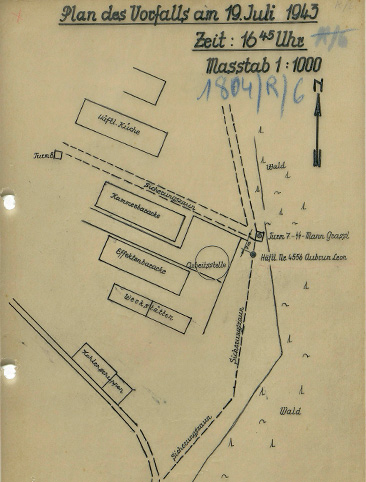
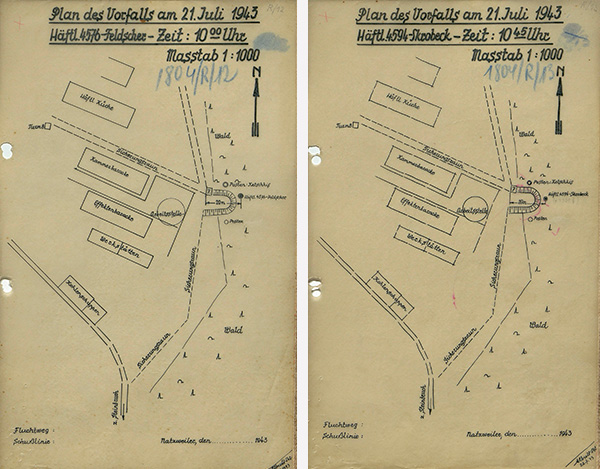
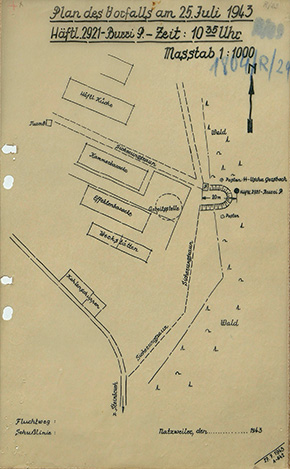
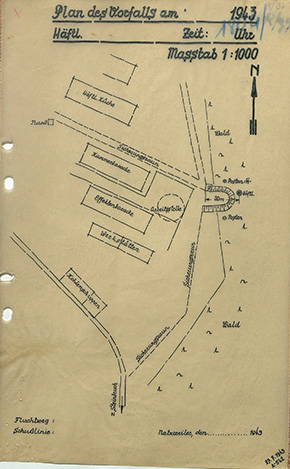
In the space of a week, between the 19th and the 27th of July 1943, eight deportees were murdered: six NNs from the convoy that left Romainville and arrived on the evening of the 15th of July 1943, and two Soviet prisoners. They were all killed in virtually the same spot (see maps). Another prisoner from the convoy of the 15th of July 1943 was injured during that week.
The victims of the “Ravine of Death”
19th July 1943
The first murder took place on the 19th of July 1943, at around 4.45 pm. The victim’s name was Léon Aubrun (4556), a Parisian printer born in 1902, married with one child, and a member of the Communist Resistance. He had been arrested on the 19th of October 1942 by the special brigade and was imprisoned in La Santé Prison, Fresnes and Fort Romainville before being deported as an NN to Natzweiler in the convoy of the 15th of July 1943. Although he was not Jewish, Fuchs considered that he had a “Jewish appearance”. As work began – the barbed-wire fence wasn’t open yet at that point – Fuchs said to the Kapo, “Nimm ihn her” (Get him). Léon Aubrun was then pushed by Van der Mühlen whilst he was emptying his wheelbarrow. He fell and became entangled in the barbed wire, where he was shot twice by the sentry at watchtower 7, SS-Mann Grassl. Wounded in the main artery, Léon Aubrun died quickly from haemorrhaging. His body was left hanging in the barbed wire.
21st of July 1943
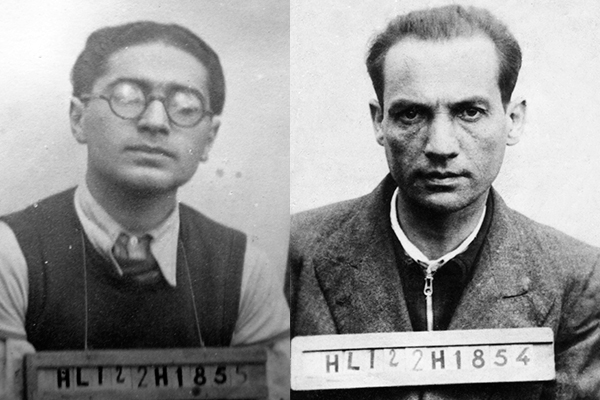
On the 21st of July 1943, the sinister process claimed two more victims: Sylvain Feldscher (4576) and Aaron Skrobek (4594), both of Jewish descent. Sylvain Feldscher, a 20-year-old medical student, was arrested in Paris and subsequently imprisoned at Cherche-Midi, Drancy and Romainville before being registered at Natzweiler on the 15th of July. His parents, Kalman and Rachelle Feldscher, were deported on the 22nd of July 1942 to Birkenau, where they were assassinated. At 10 o’clock on that day, the 21st of July 1943, at a nod from Fuchs, he was pushed by Van der Mühlen and immediately shot by SS-Mann Ketschkerch, of Hungarian origin, an “intermediate sentry” according to official terminology, stationed at the foot of the embankment. Four shots were fired, one of which struck Sylvain Feldscher in the head.
Fifteen minutes later, the same sentry fired three shots at Aron Skrobek, who was fatally struck by two bullets to the left temple; the third hit him in the left shoulder. Aron Skrobek, who worked first in the paper industry and then in the textile industry, was a Polish communist activist who spent 17 months in detention in Poland; he emigrated to France in 1936. During the Occupation, he became one of the leaders of the Jewish FTP-MOI groups under the alias “David Kutner”. He was arrested on the 16th of December 1942 in Paris and imprisoned in Cherche-Midi and then in Romainville. Since arriving at the camp, Aron Skrobek had been harassed by Fuchs, a staunch anti-Semite. A few days earlier, the SS officer had found it “amusing” to stuff stones into his mouth whilst he was lying on the ground. On the 21st of July, Aron Skrobek was thrown by Fuchs from the top of the embankment onto a pile of sharp stones and suffered a head injury. Roger Leroy took him aside, behind the pile of stones. But Fuchs, who would never let go of his prey, sent him back to work. He then ordered SS-Mann Ketschkerch to shoot Skrobek. The post-mortem report revealed the ill-treatment he had been subjected to, noting a swollen face and two large bruises on both eyelids.
22nd of July 1943
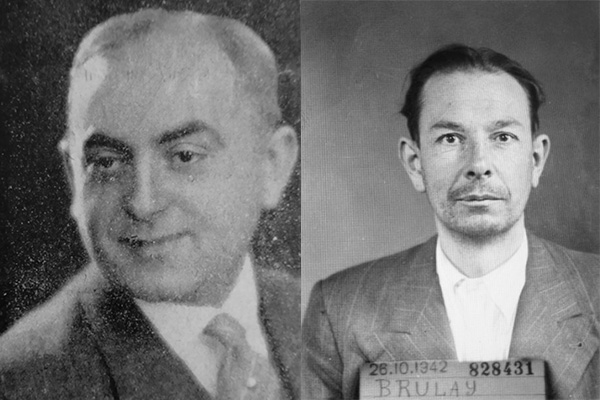
The following day, two more victims were added to the gruesome list. A Polish national of Jewish origin, born in 1896 in Gorlice, Jan-Jerzy Salomon Grenkamp-Kornfeld worked in a travel agency. Having arrived in France in December 1924, he worked from 1931 to 1939 as head of the propaganda and tourism department at the “Orbis” company, and was then employed until June 1940 at the Polish ministry of finance in Paris. He then gave German lessons and provided translation services. Before the war, he also covered journalism and economic issues in the Revue économique of Brussels and a Polish newspaper in Warsaw, La Gazetta-Handlova. He was made a Knight of the Legion of Honour in 1939 for services rendered at the 1937 International Exhibition, and was a staunch advocate of Esperanto. He was arrested on the 2nd of September 1942 and imprisoned in La Santé, Drancy and Romainville, where he was recorded as a “Jude”, even though he had declared himself to be Catholic at Natzweiler; this entry also appeared on his death certificate.
Jan-Jerzy Grenkamp-Kornfeld, who was originally assigned to the Wheelbarrow Kommando, was transferred by the German Kapo Wilhelm Kratt, who was in charge of labour, to another work unit. Fuchs noticed this and immediately went looking for him. All day long, the poor man was mistreated by Fuchs to such an extent that he could barely stand on his own two feet. On several occasions, he successfully evaded Van der Mühlen’s attempts to knock him down. But at around 1.50 pm, as he was emptying his wheelbarrow over the embankment, Van der Mühlen gave the fatal push. Grenkamp rolled down the embankment, where he was immediately mowed down by a burst of machine-gun fire from SS officer Peter Gaubatz, who was stationed at the foot of the mound. Hit by five bullets, he died from lung injuries. His body was removed by the nurses, including Nales Gerrit.
At around 3.45 pm, René Brulay (4567), having been harassed all day by Van der Mühlen, was on the verge of snapping. He was born in 1904 in Le Creusot and worked as a printer in Montreuil; he was arrested on the 19th of October 1942 by the special brigade for his involvement in the Communist Resistance. He was first detained at Fresnes and then at Romainville before being deported to KL Natzweiler. On that afternoon of the 22nd of July, standing at the top of the embankment, he opened his shirt and shouted, “This is how a Frenchman dies”. More explosions tore through the air. Gaubatz had just shot him with a burst of seven bullets, one of which struck him in the head. In total, Gaubatz fired 23 rounds for these two murders.
25th of July 1943
Peter Burri (2921) was shot dead at 10.35 am by SS-Unterscharführer Franz Gersbach. Peter Burri, aUkrainian Ostarbeiter born in 1921 in Solotuscha in the Poltava region, was arrested at the end of February 1943 in the Sarreguemines area and registered at Natzweiler on the 10th of March 1943 (Block 7). He is said to have been pushed by Van der Mühlen from the top of the mound. According to Franz Gersbach, Burri apparently tried to flee into the woods. Gersbach, who happened to be in the gap, issued the customary warnings and shot him down from a distance of twelve metres with a burst of three rounds from his submachine gun. Peter Burri drowned in his own blood after two bullets severed his pulmonary artery.
26th of July 1943
At 2 p.m., Paul Cessac (4569) was wounded by the intermediate sentry, SS-Unterscharführer Reimann. He was thrown from the top of the embankment by Van der Mühlen, rolled down, climbed back up the embankment, but was hit by a shot as he clung to the top of the mound. Having sustained an injury to his shoulder blade (or calf, according to the ITS record), he was taken to the infirmary. Paul Cessac was sent to work elsewhere for two days and ultimately returned to the Wheelbarrow Kommando with the bullet still lodged in his shoulder blade. Paul Cessac was born in Paris in 1923 and worked as a fitter in Vitry-sur-Seine. He was arrested by the special unit of the judicial police for his activities with the Communist Resistance. He was imprisoned in Fresnes and Romainville and was part of the convoy of the 15th of July 1943. On the 2nd of September 1944, he was transferred to the Dachau concentration camp, where he was registered on the 4th of September under prisoner number 98280. He was assigned to the Augsburg-Pfersee subcamp and transferred on the 29th of September to the Leonberg subcamp, where he was registered on the 2nd of October (prisoner number 29139). He was released in Leonberg and died of tuberculosis on the 13th of June 1945 at the Bir Hakeim sanatorium in Marzell.
27th of July 1943
René Bigarré (4562), born in 1903 in Paris, was a chemical engineer and industrialist in the capital. Having joined the Resistance as part of the Confrérie-Notre-Dame intelligence network in February 1942, he was arrested by the German police on the 17th of April 1942. He was imprisoned in Fresnes and then at Fort Romainville, before being deported on the convoy of the 15th of July 1943. On the 27th of July 1943, he was shot dead at 10.45 am by SS-Unterscharführer Gleich (who was executed after the war), a sentry stationed at the foot of the mound. Like Grenkamp-Kornfeld, René Bigarré had sneaked into another Kommando. Fuchs went to find him and put him back in the Wheelbarrow Kommando. René Bigarré became exhausted within a short time. Adrien Bermand wanted to replace him, but Fuchs threatened him. Bigarré had to run even harder. Van der Mühlen had already tried to throw him off the top of the embankment, but the deportee was on his guard. He approached Seuss to make him understand that he could no longer work at that pace. The “creature” slapped him twice and kicked him. Five minutes later, Van der Mühlen pushed him off the high embankment. Unterscharführer Reimann claimed another victim at 3 pm: prisoner 1754, Timofej Nagulka. Born in 1899 in Pruska, in the Orel region, an Ostarbeiter in Germany working as a farm labourer, he was arrested on the 9th of July 1942 by the Dresden Stapo for deserting his job. On the 28th of July 1942, he was registered at Buchenwald concentration camp (no. 477). He was sent to the subcamp in Cologne, then transferred on the 14th of December 1942 to KL Natzweiler, where he was registered the following day and assigned to Obernai on the same day. He was sent to the main camp on an unknown date. According to page 513 of the sentry log dated the 28th of July 1943, 18 rounds were fired on the 26th and 27th of July.
After the executions
After so many cases of “auf der Flucht erschossen” (shot whilst fleeing) – the official reason given for Abgang durch Tod – the sentries were questioned by Volkmar, an SS judicial officer. Plans were drawn up to determine the exact circumstances of the incidents (Vorfall); drawings produced by prisoner 542, Andreas Albrecht
Following the deaths, Willy Behnke, who worked for the Arbeitsdienst, arranged for Josef Van der Mühlen to be placed on a transport list. He left on the 6th of August 1943 for the Sachsenhausen concentration camp. Numerous witnesses testified that his face was swollen and he could barely stand, having been beaten up by the other prisoners. From that moment on, we lose track of him. It appears that he was beaten to death during transport or killed at Sachsenhausen by the German prisoners in his Block.
To find out more
DCAJM (Central military justice archive repository): Natzweiler trial, 1958.
SHD, DAVCC: series 21 P: files relating to the victims.
https://arolsen-archives.org/fr
https://fusilles-40-44.maitron.fr
https://www.memorialdelashoah.org