


The evacuations from KL Natzweiler
CONTENTS
- The evacuation of the main camp (September–November 1944)
- The evacuation of the subcamps on the left bank of the Rhine (September–November 1944)
- Continuity and collapse of the system (January–March 1945)
- The collapse of the system (March–April 1945)
The evacuation of the main camp (September–November 1944)
A camp saturated in the face of the Allied advance
From early August 1944, the Natzweiler concentration camp became the destination for thousands of prisoners evacuated from prisons in Rennes, Belfort, Dijon, Nancy and elsewhere. By the end of August, the camp was overcrowded, with more than 6,000 prisoners. The Allied advance, following the landings on the 6th of June 1944 and the 15th of August, made the transfer of prisoners considered as dangerous even more urgent. Meanwhile, at the main camp, fears of an attack by the resistance fighters were fuelling tensions, particularly as a Sipo-SD headquarters based in Schirmeck was coordinating operations against the resistance fighters in the Donon mountains and at the Col du Hantz.
The order to evacuate and the organisation of transfers
On the morning of the 1st of September 1944, Commander Fritz Hartjenstein received a radio order from the concentration camp inspectorate in Sachsenhausen to evacuate the camp. Within a few hours, Hartjenstein had drawn up a precise order and organised the logistics for the departure (food, trains, escort, etc.). At the same time, Gauleiter Wagner, who had arrived on site, demanded that an SS contingent remain at the camp to ensure the safety of the Germans in the valley and ensure that the dismantling of aircraft at the quarry continued. 425 deportees would remain on site.
In three convoys, which departed between the 2nd and 4th of September 1944, 5,518 prisoners were transported to the Dachau concentration camp, where they were registered between the 4th and 8th of September. 25% of them were quickly transferred to Natzweiler subcamps such as Barbe-Haslach, Dautmergen or Leonberg. The others were used as labourers in the camps at Allach or Ottobrunn, which were subcamps of Dachau.
The massacre of 141 resistance fighters
During the night of the 1st to the 2nd of September 1944, 141 members of the Resistance – 106 from the Alliance and 35 from the Alsace-Vosges Mobile Group – were taken from the Vorbruck-Schirmeck security camp to be murdered at the Natzweiler crematorium. Their bodies were immediately cremated.
This massacre was most likely the result of an initiative by the Strasbourg BdS, Erich Isselhorst, and was partially based on an order issued by Himmler on the 17th of June 1944, which stipulated that, in the event of an immediate threat to a concentration camp, the heads of the Sipo-SD were to be granted full authority to take all necessary security measures. With the military situation deteriorating, the threat of an attack by the resistance fighters looming, and telephone links with Berlin for instructions proving unreliable, it was essential that those 141 dangerous resistance fighters should not, under any circumstances, fall into the hands of the Allies. Therefore, they were quite simply eliminated.
The main camp was gradually emptied
At the main camp, after the three transports had departed, Hartjenstein remained on site with a portion of his command staff, whilst several of his units moved to Dachau. On the 8th of September, an advanced guard of the militia moved into the main camp. Clashes with the deportees prompted their transfer to the quarry. 3,000 militia members occupied the barracks until the 21st of September, before leaving for Germany.
Production at the quarry lasted only a short time, because on the 19th and 20th of September 1944, 401 prisoners were evacuated to Dachau, whilst the eight prisoners working in the Revier (infirmary) were sent to the Neckarelz subcamp.
The last departure and the discovery of the main camp
On the 11th or 17th of November 1944, Hartjenstein left the camp with his units. The camp administration set up its headquarters in Guttenbach, at the Zum Karpfe Inn, and in Binau (at the castle and school), whilst the SS garage was established in Neunkirchen.
On the 22nd of November 1944, the last sixteen prisoners left the camp. The lorry carrying them was attacked by an Allied aircraft as it was going downhill and veered off the road. Six prisoners (four from Luxembourg and two from Germany) escaped. The others were taken to Rothau station and then transferred to the subcamp at Neckarelz.
On the 25th of November 1944, the camp was discovered by a patrol from the 7th Regiment of the U.S. 3rd Infantry Division. The site was intact, with no deportees or SS officers to be seen. The first photographs were soon taken; an initial article was published in the New York Times on the 5th of December 1944.
The evacuation of the subcamps on the left bank of the Rhine (September–November 1944)
The evacuation of the subcamps on the left bank of the Rhine (September–November 1944)
By the 4th of September 1944, 18,151 prisoners had been recorded in the Natzweiler concentration camp complex. In addition to the 6,000 prisoners in the main camp, 6,500 prisoners from subcamps would be gradually evacuated, with at least 3,000 in September and 2,000 in October.
Evacuations in Moselle
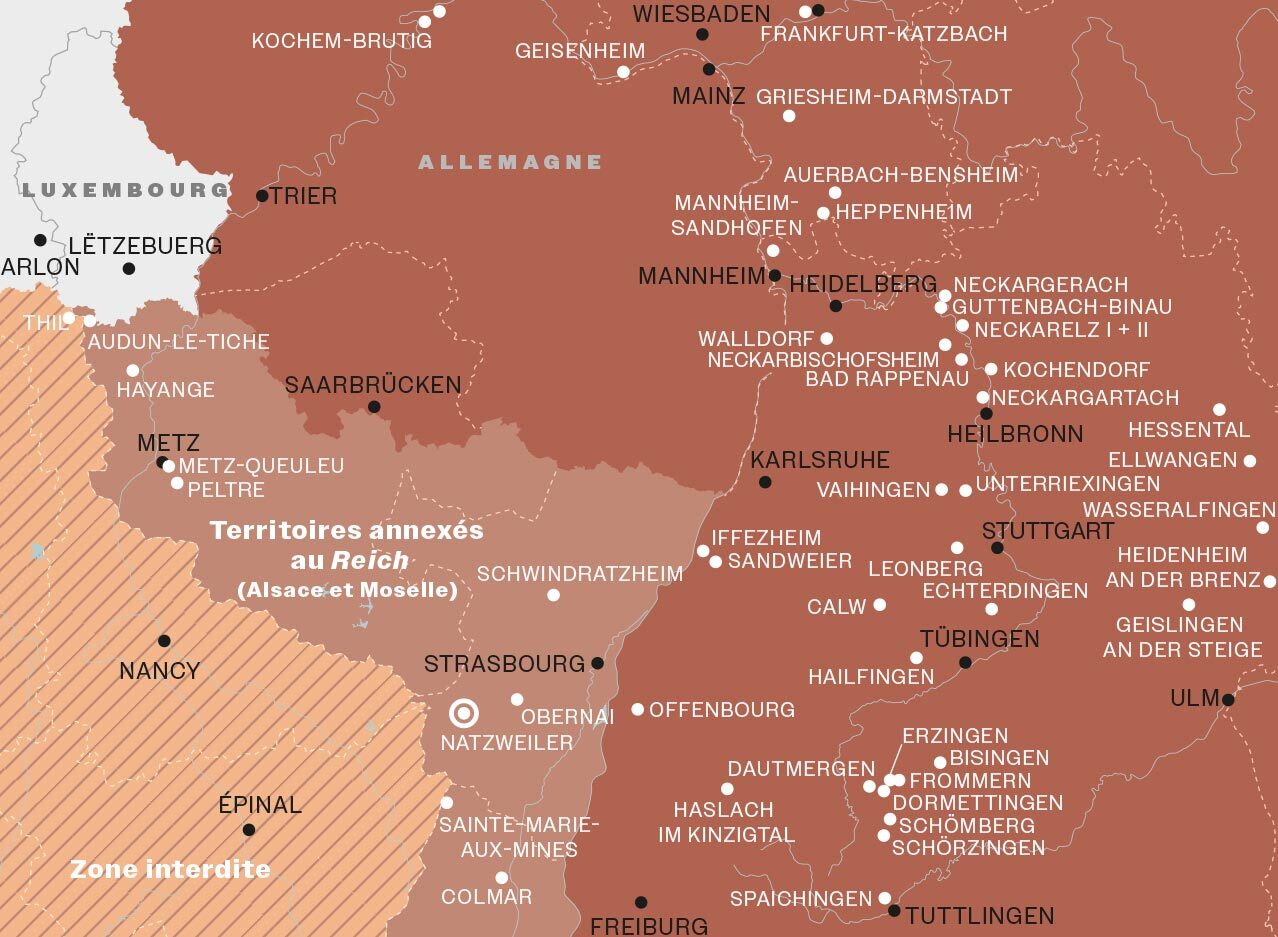
The subcamps in Moselle (Thil, Audun-le-Tiche, Hayange, Peltre and Metz) were evacuated, without any orders from Berlin, between the 28th of August and the 2nd of September. The transfer was done hastily, as Patton and his 3rd Army were positioned just outside Verdun on the 30th of August.
More than 1,650 prisoners were taken to Buchenwald (Thil), Kochendorf (Thil, Audun-le-Tiche) or Ravensbrück (500 women from Hayange, 133 of whom managed to escape along the way).
Evacuations in Alsace and West Germany
In Alsace, the subcamp at Sainte-Marie-aux-Mines was gradually evacuated between the 8th of September and the 14th of October, with some 2,000 prisoners being sent to Neckargartach, Allach – a subcamp of Dachau – or Spaichingen. The prisoners in the Wesserling subcamp were evacuated in October, mainly to the Sachsenhausen concentration camp.
In Kochem, a dreadful subcamp set up in a tunnel, close to Luxembourg and under threat from the advancing American forces, a convoy of 1,081 prisoners set off on the 15th of September for Dora, a subcamp of Buchenwald, where the V2 rockets were built.
On the 13th of October 1944, 39 pregnant Jewish women from the Frankfurt-Walldorf subcamp were sent to Auschwitz-Birkenau. The camp was finally emptied on the 23rd of November, with 1,660 women being transferred to Ravensbrück.
The other subcamps in Alsace – Cernay (25th September) and Obernai (25th and 28th September) – were also evacuated, mainly to Dachau.
Natzweiler without Natzweiler
Despite this seemingly deteriorating situation, the Natzweiler camp continued to exist – in a unique case – without a main camp, through its subcamps. 25,000 new prisoners were registered there from September 1944 onwards.
Continuity and collapse of the system (January–March 1945)
Concentration camp activities that persisted
Following the evacuations between September and November 1944, there were 20,631 prisoners recorded as of the 19th of November. Between September 1944 and March 1945, approximately thirty subcamps were still operating. Prisoners continued to work and die in factories, mines and on construction sites to prop up a war economy caught in a downward spiral, as the final catastrophe edged ever closer with each passing week.
Gradual dismantling of the subcamps
Despite the closure of several subcamps from early 1945 onwards – Echterdingen (21st of January), Wasseralfingen (5th of February), Hailfingen (14th of February) and Barbe-Haslach (15th of February) – the gruesome human grinding machine continued to operate relentlessly.
Transfers to the death camps
Meanwhile, prisoners who had fallen ill or were unable to work were transported under inhumane conditions to the death camps at Bergen-Belsen and Vaihingen. At the beginning of March 1945, around 2,250 prisoners from the camps in the “Wüste” group – Schömberg, Echterdingen, Dormettingen, Schörzingen, Erzingen, Bisingen and Frommern – were sent to Bergen-Belsen. The death toll was at least 400. In Leonberg, a convoy carrying 111 patients suffering from typhus and lung infections set off in the same direction; 80 of them did not survive the journey. On the 16th of March 1945, between 400 and 535 sick prisoners from Frankfurt-Katzbach left the camp. By the time they arrived at Bergen-Belsen, there were 16 escapees and 180 deaths. An estimated 700 sick prisoners were sent from various subcamps to the Vaihingen death camp, where they died in unspeakable conditions.
An absurd and murderous ideology
At the same time – proof, as if any were needed, of the absurdity of a system that had become uncontrollable yet ruthless in its own logic, which flouted all military or economic reality – 2,750 prisoners from Buchenwald were sent to the camps of the “Wüste” group (Dormettingen, Schörzingen, Bisingen and Dautmergen) at the beginning of March 1945, whilst 1,700 prisoners from Flossenbürg were assigned to Leonberg (1,000) and Offenburg (700).
The collapse of the system (March–April 1945)
The administrative collapse of the camp
After the sick prisoners had been evacuated in March 1945, the Natzweiler concentration camp complex collapsed within a matter of weeks, mirroring the fate of the Reich, whose territory was rapidly shrinking in both the West and the East.
The camp’s SS administration vanished between late March and early April. In Neunkirchen, the SS garages were sabotaged. The camp Kommandantur in Guttenbach disappeared, as did the units based in Binau. For example, the Politische Abteilung ceased to exist on the 25th of March 1945. The files, which had been cleared out, were finally burned on the 1st of May. The Effektenkammer, which was based at Binau Castle, was dissolved on the 29th of March.
The “death marches”
At the end of March 1945, 20,000 prisoners were still languishing and dying in the insalubrious barracks of the Natzweiler subcamps. 19,000 prisoners were subsequently evacuated. 13,000 were sent by train to Dachau and its subcamp at Allach. 7,500 prisoners were forcibly marched along the roads as part of particularly gruelling “death marches”. Of the 2,000 prisoners who left for Dachau on the 25th of March 1945, 181 were unaccounted for when they arrived on the 2nd of April. Of the 350 prisoners who set out from Frankfurt-Katzbach for Buchenwald, 68 had died by the time the convoy arrived on the 30th of March. One of the most brutal “death marches” was the one from Kochendorf. On the 30th of March, 1,200 prisoners set off on foot. They arrived in Dachau and Allach on the 2nd, 8th and 12th of April. 179 or 347 died along the way. The death camp at Vaihingen was partially evacuated from the 2nd of April. 440 and 250 prisoners, all of whom were ill, were registered at Dachau on the 7th and 9th of April. Estimates range from 12 to 200 deaths. 600 prisoners were left behind in Vaihingen and were discovered by the French army on the 7th of April. Terrifying photos of their conditions of detention were then taken and seen around the world. The camps of the “Wüste” group were massively evacuated from the 7th of April onwards, with nearly 4,800 prisoners transported by train to Allach. In mid-April, 2,500 prisoners from Leonberg were transferred to the Kaufering and Mühldorf camps, which were subcamps of Dachau.
A further 4,000 prisoners set off on foot or by train for Dachau, but, as the Allies advanced, they were abandoned in the middle of the countryside by the SS. Consequently, the sick prisoners from Neckarelz and Neckargerach, who had been transported in open wagons on the 29th of March, were abandoned at Osterbürken on the 2nd of April. Between 30 and 87 deportees lost their lives. Nearly 700 men from the Schömberg and Dautmergen camps, who had set off on foot for Tyrol on the 18th of April, were abandoned in Mittenwald on the 1st of May. 600 prisoners from Spaichingen and Bisingen regained their freedom in Steingaden on the 28th of April. A further 2,000 prisoners from Schörzingen, Bisingen and Dautmergen were released in Ostrach.
It is difficult to put an exact figure on the number of casualties
The human cost of these evacuations is very difficult to estimate. Robert Steegmann puts the death toll at around 5,000. Arno Huth estimates the death toll to be between 1,376 and 2,354 victims.
To find out more
Robert Steegmann, Struthof. Le KL-Natzweiler et ses kommandos : une nébuleuse concentrationnaire des deux côtés du Rhin. 1941-1945 Strasbourg, La Nuée Bleue, 2005
HUTH Arno, Das doppelte « Ende » des KL Natzweiler auf beiden Seiten des Rheins, Neckarelz/Landeszentrale für politische Bildung Baden-Wurtemberg, 2013.
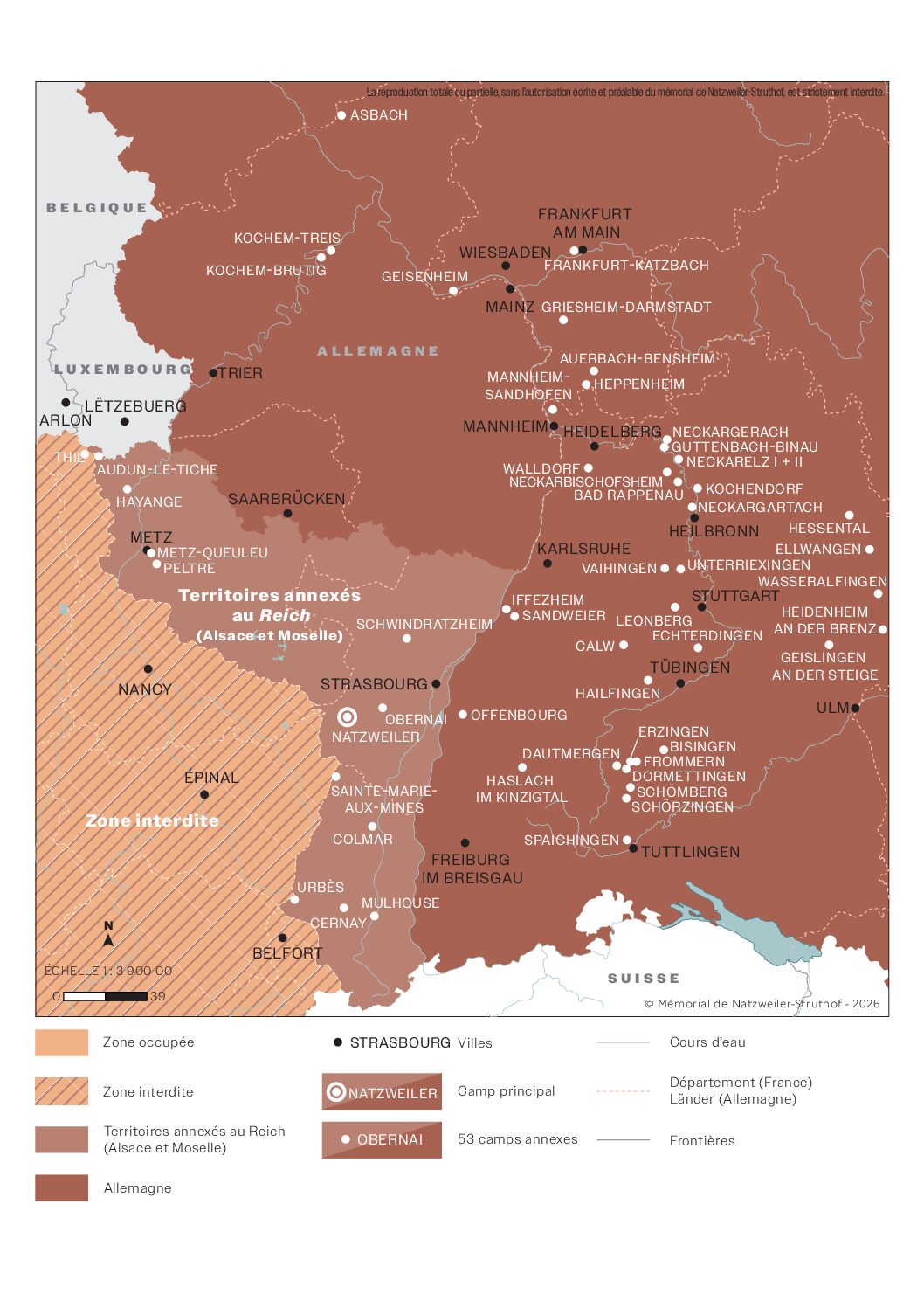
Map of the Natzweiler concentration camp and subcamps.